Supply Chain Security Market Analysis, Demand, and Growth Opportunities
Supply Chain Security Market to Reach USD 2,022.48 Million by 2034 as Cyber Risks Accelerate Demand
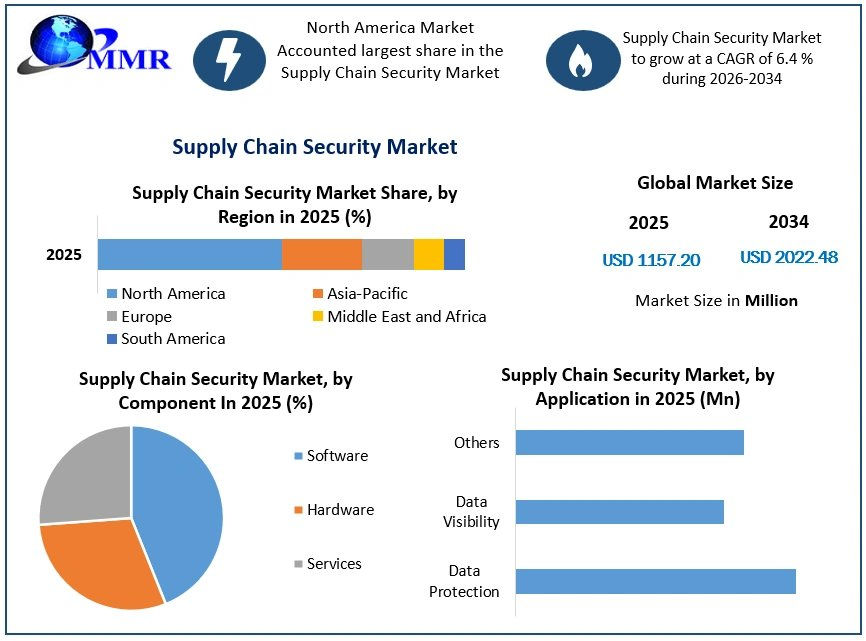
The Supply Chain Security Market was valued at USD 1,157.20 million in 2025 and is projected to grow at a CAGR of 6.4% from 2026 to 2034, reaching nearly USD 2,022.48 million by 2034. The market is gaining importance as enterprises face interconnected supplier ecosystems, cloud adoption, automation, third-party dependencies, ransomware, data breaches, counterfeit risks, and logistics disruptions. Supply chain security combines physical and cybersecurity measures to protect suppliers, vendors, transportation networks, data, software, and services. Rising demand for end-to-end visibility, traceability, data protection, and resilient operations is creating opportunities for security providers.
Growth Drivers and Opportunities
Rapid automation and digitization are major growth drivers. Connected devices, cloud platforms, IoT sensors, digital logistics systems, and software workflows improve efficiency but expand the attack surface. Organizations therefore need stronger monitoring, access controls, supplier assessment, incident response, and continuous risk management.
Ransomware and supply-chain attacks are another catalyst. A compromised supplier, software component, logistics partner, or connected device can expose multiple organizations. This is encouraging enterprises to adopt proactive third-party risk management. Blockchain-based traceability, AI-enabled threat detection, real-time monitoring, data governance, and automated compliance are emerging opportunities. Protecting sensitive business data while maintaining visibility across complex supplier networks will support sustained market expansion.
Request a Sample PDF of the Market Report : https://www.maximizemarketresearch.com/request-sample/116161/
US Market Trends and Investment
The United States remains a critical growth center because of its digitized economy, extensive supplier networks, large enterprise technology spending, and strong cybersecurity requirements. In 2025, the US government reinforced cybersecurity through Executive Order 14306, directing agencies to strengthen third-party software supply-chain security, update secure software development guidance, and improve technology protection. This policy direction is encouraging federal agencies and businesses to prioritize software integrity, vulnerability management, secure development, and supply-chain risk controls.
Investment is also shifting toward integrated security platforms. IBM and Palo Alto Networks highlighted the need to reduce fragmented security environments in 2025, while Cisco introduced AI Defense and expanded zero-trust, network visibility, AI workload, and supply-chain risk capabilities. These developments are increasing demand for security technologies that can protect complex digital supply chains.
Market Segmentation
By Component, Services held the largest market share in 2025, supported by demand for security operations, expert monitoring, incident response, and continuous protection.
By Application, Data Protection accounted for the largest market share in 2025 as companies prioritize the integrity, availability, and recovery of critical supply-chain data.
By Vertical, Retail and E-commerce held the largest market share in 2025. Omnichannel commerce, online purchasing, real-time inventory requirements, and supplier visibility are driving adoption.
Competitive Analysis
The market is fragmented, with leading companies differentiating through real-time monitoring, IoT connectivity, cloud platforms, analytics, traceability, and risk-management capabilities.
Sensitech strengthened its end-to-end visibility portfolio in 2025 with Lynx FacTOR, a SaaS solution that automates pharmaceutical product-release evaluations and can reduce assessment time from days to minutes. This supports faster decisions, compliance, and resilient cold-chain operations.
ORBCOMM expanded smart-container and supply-chain visibility capabilities in 2025. Its deployment with Folk Maritime demonstrated demand for real-time cargo monitoring and security, while its strategic transaction with S&P Global around AIS data supported further supply-chain intelligence development.
ELPRO advanced digital monitoring through liberoMANAGER 3.0 and cloud-based elproMONITOR. The platforms centralize monitoring data, improve traceability, automate workflows, and support scalable environmental monitoring. Its Monitoring-as-a-Service model also creates opportunities for subscription-based services.
Rotronic continues to provide connected monitoring through its modular Rotronic Monitoring System, combining sensors, data loggers, server software, and centralized data access. Such monitoring is increasingly important across pharmaceutical, food, laboratory, and industrial supply chains.
Emerson is strengthening supply-chain resilience through digital solutions, regionalization, multi-sourcing, supplier collaboration, and responsible sourcing practices. Its 2025 strategy emphasized supplier management, cybersecurity, ethical sourcing, and resilient operations.
Regional Analysis
North America represented the largest regional market, accounting for more than 60% of the global market according to the MMR assessment. The United States is the region’s primary growth engine because of international trade, sophisticated digital infrastructure, complex supplier networks, cybersecurity investment, and regulatory focus. Federal cybersecurity initiatives are encouraging stronger software supply-chain controls and third-party risk management. Canada and Mexico also contribute through integrated manufacturing, logistics, and trade networks.
Why This Market Matters Now
Supply chains are no longer isolated operational networks; they are interconnected digital ecosystems. A vulnerability at one supplier can affect manufacturers, retailers, logistics providers, healthcare organizations, and consumers. AI, cloud computing, IoT, automation, and connected logistics are increasing both efficiency and exposure to cyber risks.
Investing in supply-chain security can improve visibility, reduce disruption, protect sensitive data, strengthen supplier trust, support compliance, and accelerate response to emerging threats. As businesses prioritize resilience, security is becoming a strategic investment rather than a standalone IT expense.
Key Players
Sensitech, ORBCOMM, ELPRO, Rotronic, Emerson, NXP Semiconductors, Testo, Qingdao Haier Biomedical, Monnit Corporation, Berlinger & Co. AG, Signatrol, IBM, Cold Chain Technologies, LogTag Recorders, Omega Compliance, Dickson, Hangzhou Zeda Instruments, Oceasoft, Hanwell Solutions, Controlant, Tagbox Solutions, FreshSurety, Astrona Biotechnologies, Safetraces, and Tive.
Explore More Related Reports
Global Hardware Wallets Market https://www.maximizemarketresearch.com/market-report/global-hardware-wallets-market/78277/
Global Proactive Services Market https://www.maximizemarketresearch.com/market-report/global-proactive-services-market/98257/
About Maximize Market Research
Maximize Market Research Pvt. Ltd. (MMR) is a global market research and consulting company providing reliable, data-focused, and practical business insights. The firm serves healthcare, pharmaceuticals, technology, automotive, electronics, chemicals, personal care, and consumer goods. Through market forecasts, competitive analysis, strategic consulting, and industry impact assessments, MMR helps organizations understand changing market conditions, identify growth opportunities, and make informed decisions for long-term success.
Contact Us
2nd Floor, Navale IT Park Phase 3Pune Banglore Highway, NarhePune, Maharashtra 411041, India+91 9607365656sales@maximizemarketresearch.com

Comments