Semiconductor Silicon Intellectual Property Market Development Analysis and Future Scope
Semiconductor Silicon Intellectual Property Market to Reach USD 12.26 Billion by 2034, Driven by AI, Chiplets and Advanced SoC Design
The Semiconductor Silicon Intellectual Property Market is entering a strong expansion phase as semiconductor manufacturers increasingly adopt reusable processor, memory, interface, and other silicon IP blocks to reduce chip-development time, engineering costs, and design complexity. According to Maximize Market Research, the market was valued at USD 6,446.18 million in 2025 and is expected to grow at a CAGR of 7.4% from 2026 to 2034, reaching approximately USD 12,255.78 million by 2034.
The growth of advanced smartphones, artificial intelligence (AI), high-performance computing, automotive electronics, connected devices, and modern system-on-chip (SoC) architectures is creating sustained demand for semiconductor IP. Increasing chip complexity and the adoption of multicore technologies are encouraging semiconductor companies to license proven IP rather than develop every component internally. The expansion of chiplet-based architectures, advanced process nodes, AI accelerators, high-bandwidth memory, and energy-efficient computing is creating additional opportunities for IP providers.
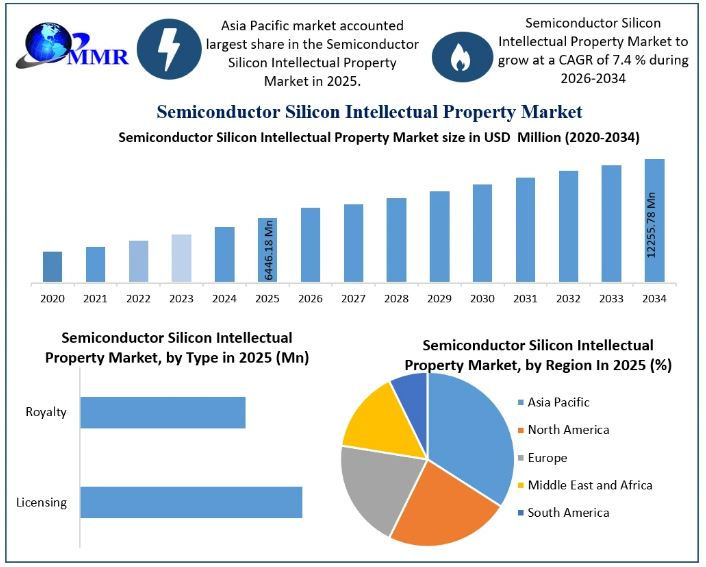
Market Estimation, Growth Drivers and Opportunities
Semiconductor silicon IP enables chip designers to integrate pre-designed and verified functional blocks into semiconductor products. This approach can shorten development cycles while supporting performance, power-efficiency, and cost optimization. The market's expansion is supported by rising smartphone penetration, growing consumer electronics demand, increasing semiconductor content in vehicles, and the development of advanced data-center infrastructure.
AI workloads are also increasing the need for specialized processor, memory, connectivity, and interface IP. Chiplet architectures represent another significant opportunity because they require reliable die-to-die communication and sophisticated interface technologies. Meanwhile, the transition toward advanced semiconductor manufacturing nodes is increasing the importance of reusable and process-optimized IP portfolios.
Opportunities are emerging across AI servers, automotive electronics, industrial systems, telecommunications, edge computing, IoT devices, and next-generation consumer electronics. However, concerns surrounding IP theft, counterfeit products, and intellectual-property protection remain important industry considerations.
Download a Free Sample of the Market Report : https://www.maximizemarketresearch.com/request-sample/15233/
U.S. Market Trends and Investment in 2025
The United States semiconductor ecosystem recorded significant investment activity in 2025, strengthening the environment for semiconductor design and silicon IP development. In June 2025, Micron announced plans for approximately USD 200 billion in U.S. semiconductor manufacturing and R&D investment, including advanced memory manufacturing and high-bandwidth memory capabilities intended to support AI-driven demand. The investment includes new and expanded facilities in Idaho, New York, and Virginia.
The U.S. government also continued supporting semiconductor manufacturing and research through the CHIPS and Science Act. In 2025, semiconductor-related funding announcements covered advanced manufacturing, materials, packaging, and research capabilities. These investments are contributing to a broader domestic semiconductor ecosystem in which advanced design technologies and silicon IP can play an increasingly important role.
Market Segmentation: Largest Segment
According to the MMR analysis, consumer electronics held the largest share by application. The segment benefits from the widespread adoption of smartphones, connected devices, advanced mobile electronics, and increasingly sophisticated consumer products.
By design, the market is divided into processor IP, memory IP, and interface IP, while revenue sources include licensing and royalty models. The report also identifies hard IP and soft IP as important design approaches, with soft IP benefiting from its flexibility and ability to be tested and optimized in virtual environments.
Competitive Analysis
The competitive landscape includes established semiconductor IP providers with extensive technology portfolios and relationships across semiconductor manufacturers, foundries, and system companies. Five prominent companies identified among the leading market participants are Arm Limited, Synopsys, Cadence, Imagination Technologies, and CEVA.
Arm Limited strengthened its position in 2025 by introducing updated Neoverse compute subsystem technologies aimed at next-generation server workloads, supporting demand for efficient computing architectures.
Synopsys expanded its silicon IP capabilities in January 2025 with the general availability of its IP solution supporting UCIe 2.0, addressing high-density die-to-die connectivity for multi-die and chiplet architectures. Such technology supports emerging AI and high-performance computing designs.
Cadence continued expanding its advanced-node IP portfolio. In 2025, the company expanded collaboration with TSMC around comprehensive 2nm IP deliverables. Cadence also completed its acquisition of Arm's Artisan foundation IP business, adding standard-cell libraries, memory compilers, and GPIO technologies optimized for advanced process nodes.
Imagination Technologies remains an important participant through its processor and graphics IP technologies, supporting applications requiring efficient computing and graphics performance.
CEVA continues to focus on specialized processor, connectivity, and edge-AI IP, supporting applications ranging from wireless communications to connected and intelligent devices.
Regional Analysis
United States: The U.S. benefits from substantial semiconductor manufacturing, R&D, AI, data-center, and chip-design investment. CHIPS-related incentives and private-sector capital spending are strengthening domestic semiconductor capabilities.
United Kingdom: The UK remains significant to the global IP ecosystem, particularly through established semiconductor architecture and processor-IP companies. Its semiconductor strategy and research ecosystem support continued innovation in chip design.
Germany: Germany's automotive and industrial electronics industries provide an important demand base for semiconductor IP. Growth in electric vehicles, advanced driver-assistance systems, industrial automation, and connected technologies supports semiconductor design requirements.
France: France's semiconductor and electronics ecosystem benefits from demand for embedded processing, automotive electronics, telecommunications, and industrial applications, creating opportunities for specialized silicon IP.
Japan: Japan's advanced electronics, automotive, industrial, and semiconductor manufacturing ecosystem supports demand for processor, memory, and interface IP as companies develop increasingly sophisticated electronic systems.
China: China's large consumer electronics and semiconductor ecosystem provides substantial demand for silicon IP. Strong smartphone production, automotive electronics, connected devices, and increasing electronic content in vehicles contribute to market opportunities.
Key Players
Key companies profiled in the market include Arm Limited, Synopsys, Cadence, Imagination Technologies, CEVA, Lattice Semiconductor, Vivante, Kilopass Technology, Atmel, Intel, Rambus, Mentor Graphics, Renesas Electronics, eMemory Technology, Silab Tech, Open-Silicon, Dream Chip Technologies, Achronix Semiconductor, Sonics, Xilinx, CORTUS, Digital Blocks, Dolphin Integration, Altera, CAST, and EnSilica.
Why This Market Matters Now
The semiconductor industry is moving toward more complex architectures, AI-enabled computing, chiplets, advanced-node manufacturing, and increasingly specialized electronic systems. These developments make reusable, verified, and performance-optimized silicon IP increasingly important for reducing design complexity and accelerating time to market.
With the market projected to reach USD 12.26 billion by 2034, semiconductor IP is positioned as an important enabling layer for the next generation of AI, automotive, telecommunications, consumer electronics, industrial, and data-center technologies.
Explore More Related Reports:
Global Smart Home Energy Management Device Market https://www.maximizemarketresearch.com/market-report/global-smart-home-energy-management-device-market/54435/
Gesture Recognition Market https://www.maximizemarketresearch.com/market-report/global-gesture-recognition-market/36294/
About Maximize Market Research
Maximize Market Research Pvt. Ltd. (MMR) is a global market research and consulting company that provides reliable, data-focused, and practical business insights. The firm serves a wide range of industries, including healthcare, pharmaceuticals, technology, automotive, electronics, chemicals, personal care, and consumer goods. Through market forecasts, competitive analysis, strategic consulting, and industry impact assessments, MMR helps organizations understand changing market conditions, identify growth opportunities, and make informed business decisions for long-term success.
Contact Us
2nd Floor, Navale IT Park Phase 3Pune Banglore Highway, NarhePune, Maharashtra 411041, India+91 9607365656sales@maximizemarketresearch.com


Comments