Flooring Market Growth Trends, Demand Drivers, and Future Opportunities
Flooring Market to Reach USD 825.42 Billion by 2032, Driven by Renovation and Sustainable Materials
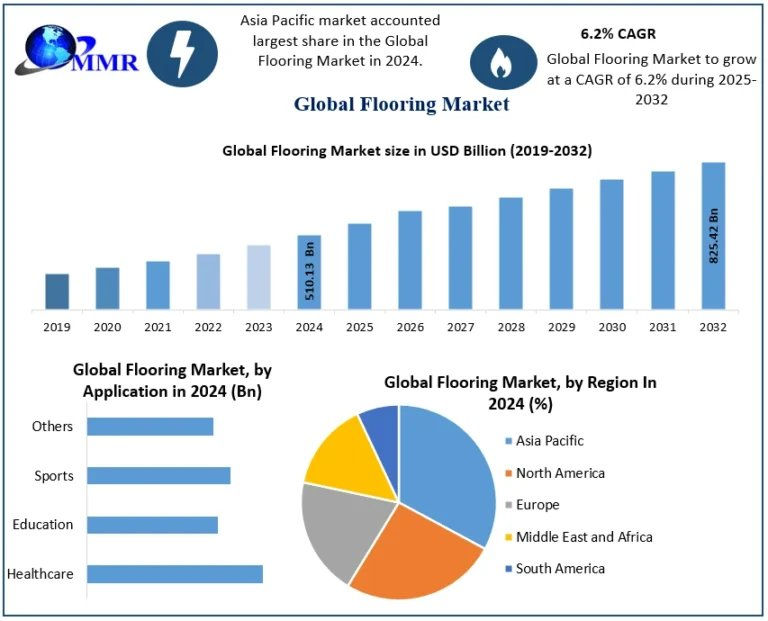
The Flooring Market is experiencing steady expansion, supported by increasing construction activities, residential renovation projects, commercial infrastructure development, and rising demand for durable and visually appealing flooring solutions. According to Maximize Market Research, the Flooring Market was valued at USD 510.13 billion in 2024 and is projected to reach nearly USD 825.42 billion by 2032, growing at a compound annual growth rate (CAGR) of 6.2% from 2025 to 2032. Growing urbanization, investments in residential and commercial buildings, and advancements in flooring materials are expected to create significant opportunities for manufacturers and suppliers worldwide.
Flooring Market Estimation, Growth Drivers, and Opportunities
The Flooring Market continues to benefit from global infrastructure development, population growth, urban expansion, and increasing consumer expenditure on home improvement. Residential construction generates demand for flooring products that combine comfort, durability, affordability, and aesthetic appeal. Meanwhile, commercial buildings, offices, healthcare facilities, educational institutions, hotels, and retail spaces require flooring that withstands heavy foot traffic and meets specific safety and maintenance requirements.
Technological advancements are also influencing market growth. Manufacturers are developing waterproof surfaces, scratch-resistant finishes, easy-to-install flooring systems, and products that replicate the appearance of natural wood and stone. Luxury vinyl tile, engineered wood, laminate, ceramic tiles, and other innovative materials are attracting buyers seeking performance and design flexibility.
Sustainability represents another important growth opportunity. Demand for recycled content, responsibly sourced wood, low-emission adhesives, and flooring materials with improved environmental performance is encouraging product innovation. Renovation and remodeling activities also provide opportunities in mature construction markets, where consumers increasingly replace outdated flooring instead of undertaking complete property reconstruction. Despite these opportunities, raw material price fluctuations, installation costs, and environmental compliance requirements may influence profitability and purchasing decisions.
Get Your Free Sample Report Link : https://www.maximizemarketresearch.com/request-sample/11376/
United States Market: Trends and Investment in 2025
The United States remains an important market for flooring products because of its established residential construction sector, extensive housing stock, and continued interest in property renovation. In 2025, manufacturers and retailers focused on resilient flooring, waterproof luxury vinyl products, engineered wood, and practical solutions designed for busy households and commercial environments. Homeowners increasingly considered durability, maintenance requirements, installation time, and long-term value when selecting flooring. Investment opportunities also emerged from renovation projects, multifamily housing, hospitality properties, and commercial space upgrades. Product development increasingly emphasized realistic wood and stone finishes, improved surface protection, and designs that complement contemporary interiors. However, mortgage affordability, construction financing costs, and uncertainty in housing activity continued to influence demand. These conditions encouraged suppliers to balance premium product innovation with competitively priced options for renovation contractors and budget-conscious consumers.
Flooring Market Segmentation: Leading Categories
The Flooring Market is segmented by type, material, application, and end user. Among these categories, the commercial end-user segment held the largest revenue share in 2024, supported by demand from offices, hospitals, educational facilities, hotels, retail establishments, and other commercial buildings. These environments require durable, safe, hygienic, and easy-to-maintain flooring solutions.
Within the resilient flooring category, vinyl flooring represents a prominent segment because of its waterproof properties, affordability, durability, and design versatility. Vinyl products are widely used in residential renovations and commercial interiors where resistance to stains, moisture, and everyday wear is important. Ceramic, stone, wood, laminate, carpets, and rugs also serve distinct applications across the global market.
Competitive Analysis: Five Major Flooring Companies
The global Flooring Market features established manufacturers competing through product development, sustainability initiatives, manufacturing capabilities, distribution networks, and design innovation. Five prominent companies include:
Mohawk Industries, Inc.
Mohawk Industries maintains a broad portfolio covering ceramic tile, carpet, laminate, hardwood, and resilient flooring. In 2025, the company highlighted innovations in sustainable flooring, including PureTech products incorporating renewable, plant-based materials and SolidTech R flooring featuring recycled materials. These developments support demand for durable surfaces with improved environmental characteristics.
Shaw Industries Group, Inc.
Shaw Industries supplies residential and commercial flooring, including carpet, hardwood, laminate, and resilient products. Its manufacturing strategy combines domestic production with global sourcing. Continued development of resilient flooring and products designed for commercial applications helps the company respond to changing customer preferences and supply-chain requirements.
Tarkett Group
Tarkett offers vinyl, linoleum, carpet, wood, and sports flooring solutions. The company emphasizes circular-economy initiatives, material recovery, and product designs that support indoor environmental quality. Investment in recyclable materials and resource-efficient manufacturing can strengthen its position as building owners increasingly consider environmental performance.
Armstrong Flooring, Inc.
Armstrong Flooring has historically been associated with resilient flooring, particularly vinyl products for residential and commercial environments. The broader Armstrong flooring business and its associated assets have undergone ownership and operational changes, so current product portfolios and corporate arrangements should be distinguished from historical operations. Innovation in resilient surfaces, installation systems, and maintenance efficiency remains important to this product category.
Interface, Inc.
Interface specializes in modular carpet tiles and resilient flooring for commercial interiors. In April 2025, the company announced the incorporation of captured carbon into manufacturing processes for carpet tile products in the United States and Europe. This initiative demonstrates how alternative raw materials can reduce product carbon footprints while maintaining performance and design standards.
These companies operate in a competitive landscape where product quality, pricing, environmental credentials, manufacturing efficiency, and customer service influence purchasing decisions. Their innovations may encourage wider adoption of high-performance flooring across residential and commercial projects.
Regional Analysis: United States, United Kingdom, Germany, France, Japan, and China
United States: Renovation demand, commercial construction, and investments in multifamily housing support flooring consumption. Building owners increasingly prioritize durability, affordability, and easy maintenance. Energy-efficient building improvements and green-building practices also encourage interest in flooring materials with documented environmental performance.
United Kingdom: Housing refurbishment, commercial property modernization, and demand for attractive, low-maintenance interiors support the market. Building regulations and sustainability requirements encourage manufacturers to consider material efficiency, indoor air quality, and responsible sourcing.
Germany: Renovation projects, industrial facilities, and sustainability-focused construction support demand. European environmental requirements, including chemical restrictions and circular-economy initiatives, influence flooring product development and material selection.
France: Residential refurbishment, hospitality projects, and public infrastructure upgrades create opportunities for flooring manufacturers. Greater attention to building energy performance and environmentally responsible construction encourages investment in durable and resource-efficient products.
Japan: Renovation of existing buildings, urban redevelopment, and demand for practical interior materials support flooring adoption. Space-efficient housing designs, durability requirements, and interest in easy-to-clean surfaces influence purchasing decisions.
China: Urbanization, residential development, commercial construction, and infrastructure investment continue to shape demand. Domestic manufacturing capacity and a broad supply chain support the availability of ceramic, vinyl, wood-based, and other flooring products. Building-quality standards and environmental initiatives also encourage improvements in manufacturing efficiency and product performance.
Asia-Pacific held the largest regional share of the global Flooring Market in 2024, supported by infrastructure expansion and construction activity. Country-specific market shares for the six markets above are not quantified here.
Key Players in the Flooring Market
Mohawk Industries, Inc.
Shaw Industries Group, Inc.
Tarkett Group
Armstrong Flooring, Inc.
Interface, Inc.
Gerflor Group
Beaulieu International Group
Forbo Holding AG
Mannington Mills, Inc.
Kährs Group
James Halstead PLC
Parador GmbH
Amtico International
Milliken & Company
Swiss Krono Group
Why This Market Matters Now
The Flooring Market matters because flooring is an essential component of residential construction, commercial infrastructure, and building renovation. Increasing expectations for durability, attractive designs, low maintenance, and sustainable materials are reshaping product development. Manufacturers that combine performance improvements with competitive pricing and responsible material sourcing may be better positioned to capture emerging opportunities.
With the market projected to reach USD 825.42 billion by 2032, stakeholders can explore opportunities in resilient flooring, commercial applications, renovation projects, and environmentally conscious product innovation. Strategic investment in technology, distribution, and manufacturing efficiency will remain important for long-term competitiveness.
Explore More Related Reports
Global Flexographic Ink Market https://www.maximizemarketresearch.com/market-report/global-flexographic-ink-market/31279/
Global Photoinitiators Market https://www.maximizemarketresearch.com/market-report/global-photoinitiators-market/72157/
About Maximize Market Research
Maximize Market Research Pvt. Ltd. is a global market research and consulting company providing data-focused business insights across healthcare, pharmaceuticals, technology, automotive, electronics, chemicals, personal care, and other industries. Through market forecasts, competitive analysis, and strategic consulting, the company helps organizations understand evolving market conditions and identify opportunities for sustainable business growth.
Contact Us
Maximize Market Research Pvt. Ltd.2nd Floor, Navale IT Park Phase 3Pune Bangalore Highway, NarhePune, Maharashtra 411041, IndiaPhone: +91 9607365656Email: sales@maximizemarketresearch.com


Comments