5G Market in Aviation Future Scope and Projected Industry Growth Report by MMR
5G Market in Aviation Set to Reach US$ 115.92 Billion by 2034, Driven by Smart Airport Development and Advanced Connectivity
Market Estimation, Growth Drivers and Opportunities
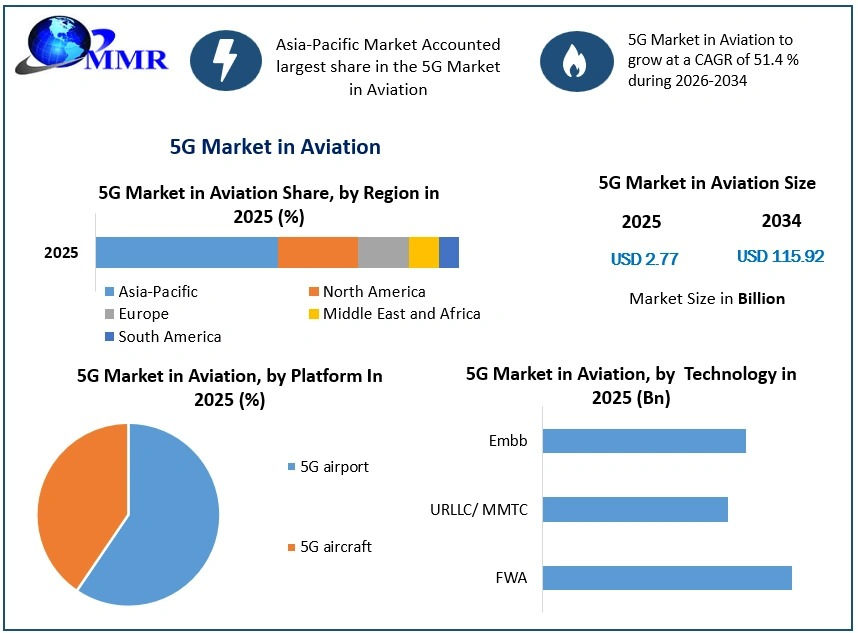
The 5G Market in Aviation is witnessing remarkable growth as airlines, airports, and aviation technology providers increasingly adopt advanced wireless communication infrastructure. According to Maximize Market Research, the market was valued at US$ 2.77 billion in 2025 and is projected to reach US$ 115.92 billion by 2034, registering a CAGR of 51.4% during the forecast period. The increasing demand for high-speed connectivity, real-time communication, automated airport operations, and connected aircraft is creating significant opportunities for market participants.
The growing adoption of the Internet of Things (IoT), artificial intelligence (AI), cloud computing, and data-driven aviation operations is supporting market expansion. 5G technology enables faster data transmission, lower latency, and improved network reliability compared with previous wireless generations. These capabilities are essential for applications such as intelligent baggage handling, predictive aircraft maintenance, real-time flight monitoring, passenger information systems, and advanced in-flight entertainment. Furthermore, increasing passenger traffic and investments in smart airport infrastructure are encouraging aviation operators to upgrade their existing communication networks. The expansion of unmanned aerial vehicles (UAVs), autonomous ground vehicles, and advanced air mobility services is also creating new opportunities for 5G infrastructure providers.
US Market Trends and Investments
The United States is emerging as an important innovation centre for 5G adoption in aviation, supported by investments in private wireless networks, aircraft connectivity, and smart airport infrastructure. In 2025, NASA conducted research and flight testing to evaluate how 5G-based communication networks could support future air taxi operations and advanced air mobility. The research explored the potential of cellular technology for reliable communication between aircraft and ground infrastructure. Additionally, Gogo advanced its next-generation 5G Air-to-Ground (ATG) connectivity programme through successful technology testing and collaboration with Airspan Networks and GCT Semiconductor. Ericsson also highlighted private 5G applications for airport infrastructure, including computer vision, connected devices, and automated baggage operations. These developments demonstrate increasing investment in aviation connectivity and the development of advanced wireless solutions across the American aviation industry.
Get Your Free Sample Report Link : https://www.maximizemarketresearch.com/request-sample/106910/
Market Segmentation Analysis
According to Maximize Market Research, the 5G Market in Aviation is segmented by platform, technology, communication infrastructure, and 5G services.
By Technology: The Enhanced Mobile Broadband (eMBB) segment held a significant market share in 2025. Its dominance is supported by increasing demand for high-speed internet connectivity, cloud-based services, real-time video streaming, and advanced in-flight entertainment. eMBB enables passengers and aviation professionals to access high-bandwidth applications while improving communication capabilities across airport and aircraft environments.
Competitive Analysis
The competitive landscape of the global 5G Market in Aviation includes telecommunications providers, aviation technology developers, and wireless infrastructure companies. Five prominent companies influencing market development include:
Cisco Systems: Cisco provides advanced networking infrastructure and 5G core solutions supporting aviation connectivity. Its collaboration with Gogo focuses on developing a dedicated 5G Air-to-Ground network. The integration of Cisco's 5G core technology with existing aviation infrastructure supports scalable connectivity, improved network capacity, and reliable in-flight internet services.
Ericsson: Ericsson is strengthening its position through private 5G networks designed for smart airport operations. In 2025, its collaboration with Saab and Purdue University demonstrated the potential of private 5G for connected airport technologies. Its innovations support autonomous ground vehicles, real-time communications, airport surveillance, and automated baggage management.
Nokia Corporation: Nokia is developing advanced 5G networking infrastructure, including radio access networks, cloud-based connectivity, and private wireless solutions. Its AirScale portfolio supports high-capacity wireless communication, while its network technologies provide opportunities for airports seeking reliable and scalable digital infrastructure.
Huawei Technologies: Huawei continues to develop advanced 5G infrastructure, including massive MIMO antennas, radio access networks, and wireless communication solutions. Its technological capabilities support connected airport environments, high-speed data transmission, and intelligent aviation applications, particularly across Asian markets.
Gogo Inc.: Gogo is investing in next-generation aircraft connectivity through its 5G ATG network. Its collaboration with Airspan Networks and technology partners supports the development of high-speed air-to-ground communication. The company's aviation-specific connectivity solutions aim to improve broadband performance, network reliability, and passenger experiences.
Regional Analysis
United States: The US market benefits from strong telecommunications infrastructure, advanced aerospace capabilities, and investments in connected aircraft. Federal aviation authorities and telecommunications regulators continue working on 5G spectrum coordination and aircraft radio-altimeter safety. NASA's advanced air mobility research and private 5G airport projects are further supporting technological development.
United Kingdom: The UK aviation industry is adopting digital infrastructure to improve airport efficiency, passenger connectivity, and operational communication. Government initiatives supporting 5G deployment and digital transformation are creating opportunities for aviation technology providers.
Germany: Germany benefits from its established aerospace, telecommunications, and industrial technology sectors. Investments in digital aviation infrastructure, automation, and private wireless networks are supporting the adoption of advanced connectivity solutions.
France: France is advancing airport digitalization through improved operational communication and private cellular infrastructure. In 2025, Ericsson and Streamwide demonstrated 5G-ready communication capabilities at major Paris airports, supporting workforce coordination and airport operational efficiency.
Japan: Japan's advanced telecommunications ecosystem and investments in smart infrastructure are supporting aviation digitalization. The country's focus on autonomous technologies, robotics, and connected transportation creates opportunities for aviation-related 5G applications.
China: China represents an important growth market because of its extensive 5G infrastructure, domestic telecommunications capabilities, and investments in aviation modernization. Government-backed digital infrastructure development and the presence of major technology providers are supporting market expansion.
Asia-Pacific held the highest regional market share in 2025, supported by increasing aviation infrastructure investments and technological advancements. Country-specific market share percentages are not separately disclosed in the referenced market assessment.
Key Players
Aeromobile Communications
Cisco Systems
Ericsson
Global Eagle Entertainment
Gogo
Huawei
Inseego Corp.
Intelsat
Nokia Corporation
ONEWEB
Panasonic Avionics Corporation
SmartSky Networks
Deutsche Telekom AG
KT Corporation
SK Telecom Co. Ltd.
T-Mobile US Inc.
Why This Market Matters Now
The 5G Market in Aviation represents an important opportunity for the global aerospace and telecommunications industries. Increasing passenger expectations, airport modernization, connected aircraft, and autonomous aviation technologies are accelerating demand for reliable wireless communication. 5G-enabled infrastructure can improve operational efficiency, enhance passenger experiences, strengthen aircraft connectivity, and support real-time data exchange. As aviation operators prioritize digital transformation, investments in advanced wireless networks are expected to increase. The market's projected growth highlights its importance for technology developers, investors, airport authorities, airlines, and telecommunications providers seeking long-term opportunities in the evolving aviation ecosystem.
About Maximize Market Research
Maximize Market Research Pvt. Ltd. (MMR) is a global market research and consulting company that provides reliable, data-focused, and practical business insights. The firm serves a wide range of industries, including healthcare, pharmaceuticals, technology, automotive, electronics, chemicals, personal care, and consumer goods. Through market forecasts, competitive analysis, and strategic consulting, MMR helps organizations understand changing market conditions, identify growth opportunities, and make informed business decisions for long-term success.
Contact Us
Maximize Market Research Pvt. Ltd.
2nd Floor, Navale IT Park Phase 3Pune Banglore Highway, NarhePune, Maharashtra 411041, India
Phone: +91 9607365656Email: sales@maximizemarketresearch.com


Comments